Jan 2025 - May 2025
• Sponsored Project
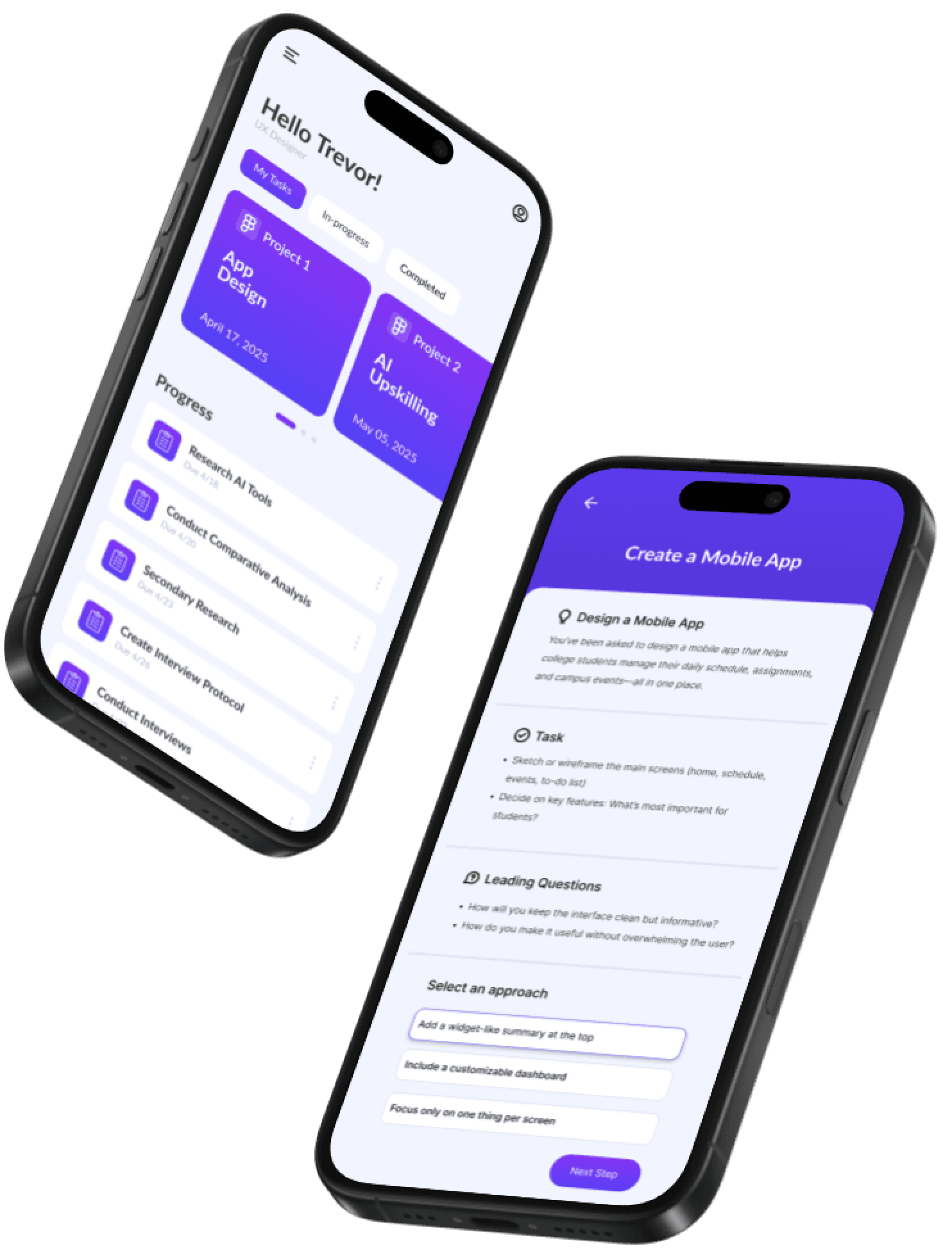
Overview
Brief
Explored how artificial intelligence can support professional upskilling
Role
Product Designer
Timeline
16 Weeks
Team
Jun Hyok Lim
Ashton Sun
Kaylee Young
Aishwarya Gorantla
Mahi Tripathi
Mustafa Arshad
Tuan Nguyen
Arya Qiu
Duong Le
Background
Professional Upskilling
In a rapidly changing job market, upskilling is no longer option but the path forward is often unclear. While AI offers powerful opportunities to personalize and scale learning, users remain skeptical of its role in critical skill development.
Our team partnered with Key Lime Interactive, to explore how AI can meaningfully support professional upskilling without replacing human guidance. This project focused on understanding user needs, identifying opportunity gaps, and designing AI-assisted solutions grounded in trust, structure, and real-world relevance.
Current State
Pain points
1
Users struggle to find clear, structural paths for what to learn next
2
Soft skills and real-world experience are difficult to develop digitally
3
Users are hesitant to rely on AI or existing tools for skill development.
Goal
Guiding question
How might we integrate AI into the upskilling process to balance personalization, credibility, and human interaction for early career professionals?
Make it easier to
navigate career growth
personalize learning
identify skill gaps
apply real-world skills
receive actionable feedback
navigate career growth
Approach
Design process
We structured the project into three connected phases, where each phase directly informed the next:
Research
1
Build a foundational understanding of upskilling behaviors, AI perceptions, and existing market solutions.
Ideation
2
Translate research insights into opportunity areas and generate potential solutions.
Prototyping & Testing
3
Validate concepts through user feedback and iterate into mid-fidelity designs.
Research
Secondary Research
To establish a baseline understanding of AI and upskilling, I reviewed academic literature, industry reports, and real user discussions. This helped me identify existing trends, challenges, and assumptions, which informed the direction of the primary research.
Continuity
Upskilling is an ongoing process rather than a one-time learning event
Efficiency
AI is most effective when supporting repetitive or low-complexity tasks
Human-Centeredness
Human guidance remains essential for meaningful skill development
Research
Comparative Analysis
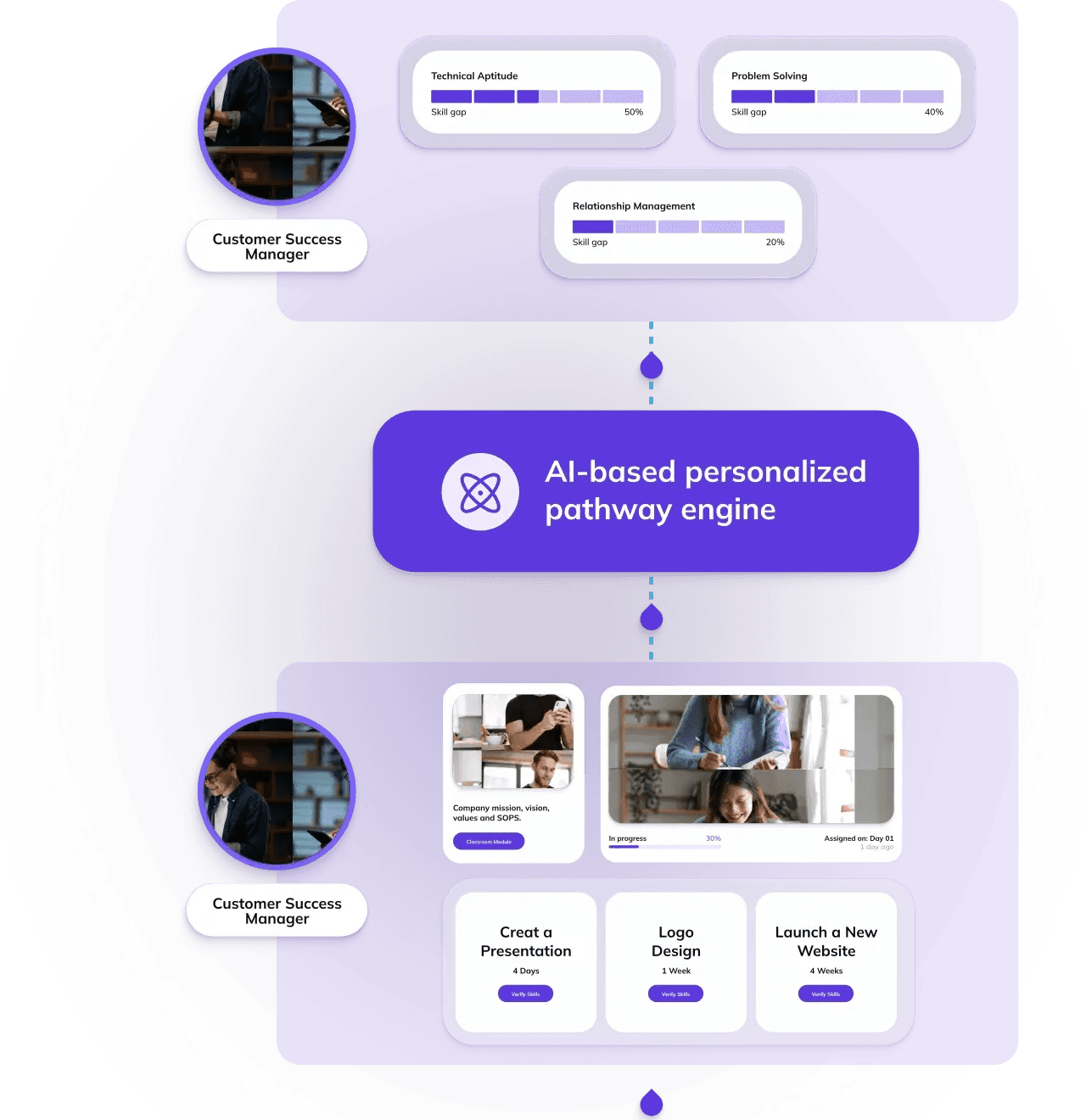
I analyzed existing AI-powered upskilling platforms to understand what solutions currently offer and where they fall short. This allowed me to identify common patterns and gaps that could inform future opportunities.
Generic Recommendation
AI personalization across platforms often feels broad and not tailored to individual goals or skill levels
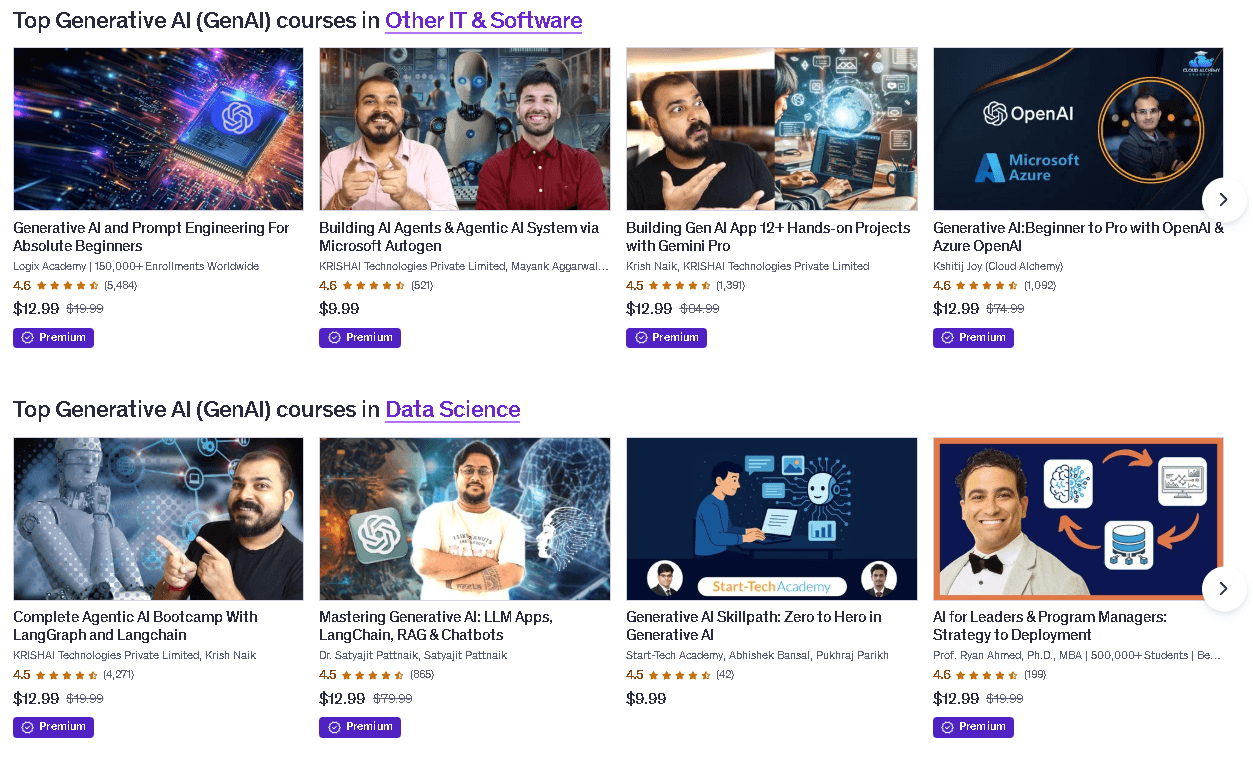
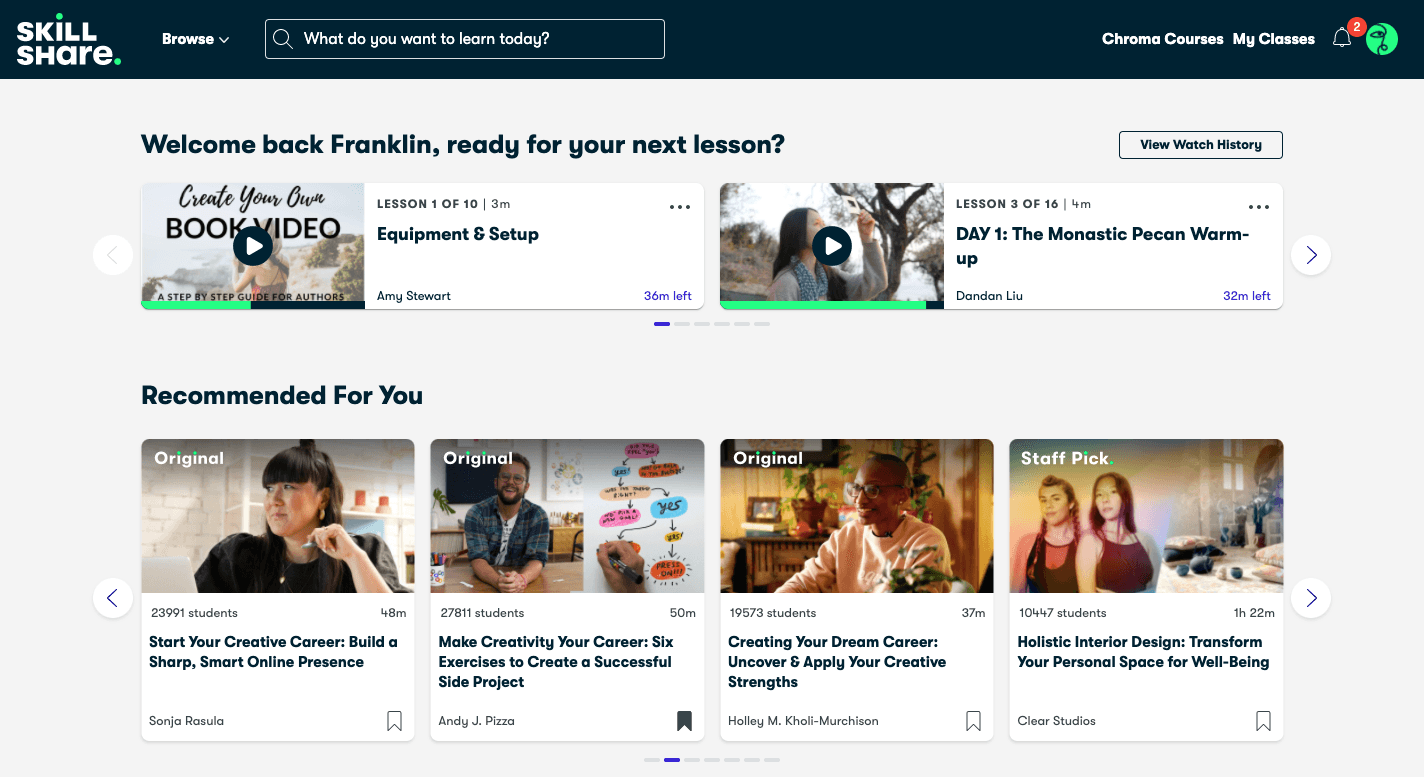
Inconsistent Quality
The quality of courses and learning resources varies widely, making it hard for users to trust the platform
Limited Human Support
Most platforms rely heavily on self-learning and AI, with limited access to mentors, feedback, or peer interaction
Research
Swot Analysis

Building on the comparative analysis, I evaluated strengths, weaknesses, opportunities, and threats across platforms. This helped us assess market viability and uncover areas where new solutions could differentiate.
Research
Survey & Interview
To ground our findings in real user experiences, I conducted surveys and interviews with students, early-career professionals, experienced professionals, and hiring managers. This provided both quantitative patterns and deeper qualitative insight.
Unclear Learning Direction
Users often feel overwhelmed when learning paths are unstructured and resources are scattered.
Cautious AI Adoption
AI is used frequently, but users hesitate to rely on it for evaluation or high-stakes feedback.
Real-world experience
Hands-on projects and applied learning are seen as more valuable than certificates or passive coursework.
Research
Affinity Mapping
I synthesized insights from all research methods using affinity mapping to transform raw data into clear themes that would guide ideation.

Ideation
Translating Insights into opportunities
Using synthesized research insights, I identified key gaps in the upskilling experience and translated them into opportunity areas that guided ideation.
Lack of human feedback
Mismatch in learning styles
Inconsistent course quality
Weak soft-skill development
Low trust in AI
Inefficient learning paths
Ideation
Ideating potential solutions
After identifying gaps based on our primary and secondary research, I mapped out possible solutions that address those gaps.

Ideation
Crazy 8s Ideation Workshop
We conducted a Crazy 8s workshop to rapidly explore a wide range of solutions addressing the identified gaps before narrowing our focus.

Interview
Value Proposition Testing
We tested sketches with users to evaluate clarity, perceived value, and relevance, using feedback to decide which concepts to refine.
AI should guide, not Judge
Users preferred AI that offers supportive suggestions rather than authoritative evaluations or final judgments.
Clear mentorship Structure
Clear roles and expectations were necessary to prevent imbalance and confusion in mentorship features.
Mobile Access
Mobile access made it easier for users to maintain regular upskilling habits in their daily routines.

Prototyping
Mid-Fidelity Prototyping
Based on earlier feedback, we refined selected concepts into mid-fidelity wireframes and tested them with users to evaluate structure, usability, clarity, and trust.
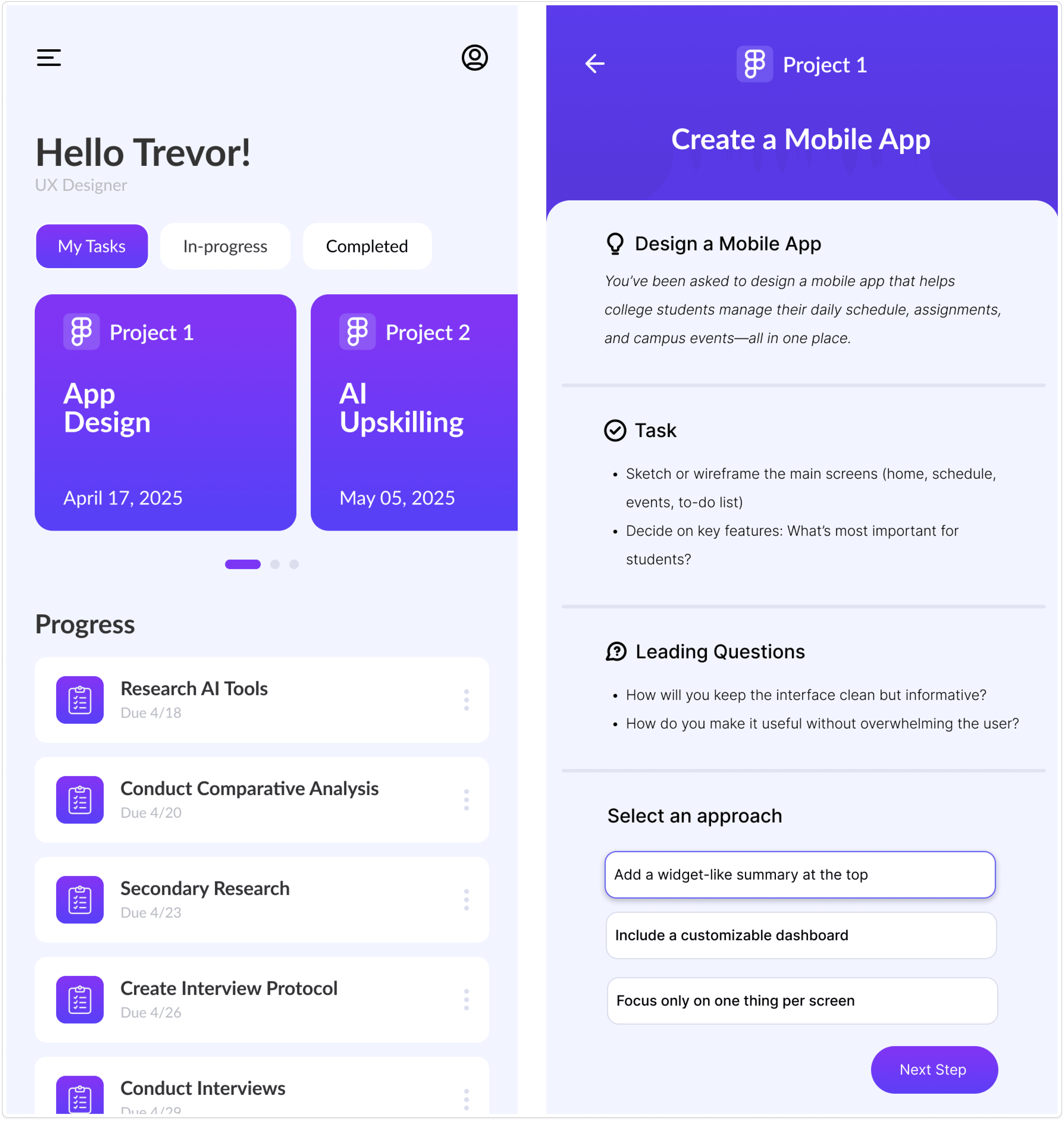
It is valuable for Job Orientation and refine technical skills
Ideal for learners exploring new skills or job functions
Helps simulate job tasks for real-world prep
Users wanted to set goals/preferences for more personalized AI guidance
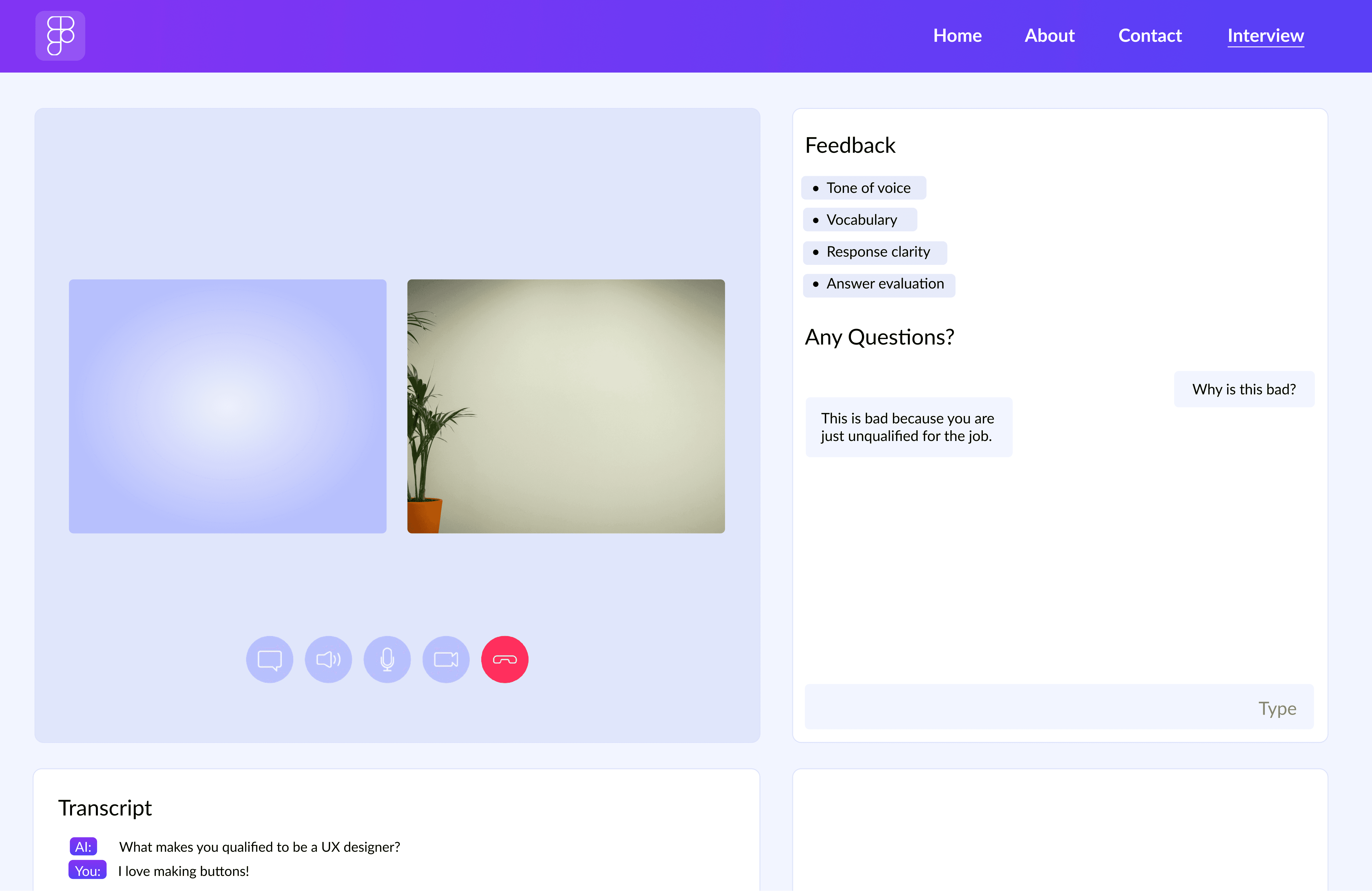
I really like the constructive feedback, interviews are important.
Users value receiving feedback both during and after interviews.
Users are comfortable with AI helping evaluate interview performance.
Interview practice should adapt to different interview types, such as technical or behavioral.
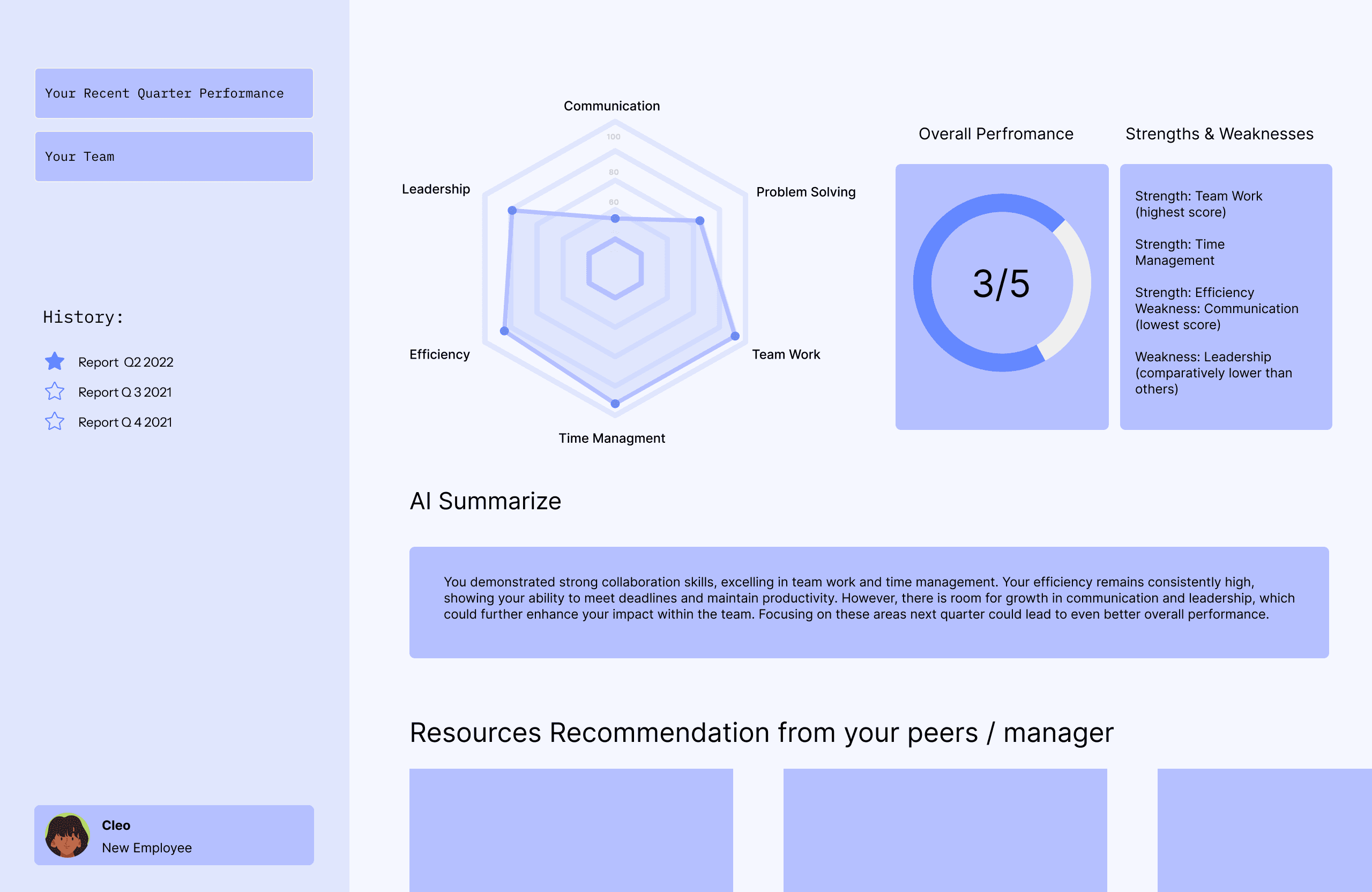
It’s helpful to see my weak areas clearly so I know exactly what to work on next.
Analyzing score and graph / Show your strength and weakness
AI Summarizes feedback from your manager and peers
Recommends Internal resources for you
What I learned
Research-Driven Design
This project reinforced how making design decisions in research, rather than assumptions, leads to more relevant and user-centered AI experiences.
Human-Centered Thinking
I learned that while AI improves efficiency, users still need guidance, clarity, and flexibility, making human-centered design essential.
Growth Through Collaboration
Collaborating with a diverse team strengthened my communication and problem-solving skills and showed how iteration and feedback improve design outcomes
Jan 2025 - May 2025
• Sponsored Project
Overview
Brief
Explored how artificial intelligence can support professional upskilling
Role
Product Designer
Timeline
16 Weeks
Team
Jun Hyok Lim
Ashton Sun
Kaylee Young
Aishwarya Gorantla
Mahi Tripathi
Mustafa Arshad
Tuan Nguyen
Arya Qiu
Duong Le
Background
Professional Upskilling
In a rapidly changing job market, upskilling is no longer option but the path forward is often unclear. While AI offers powerful opportunities to personalize and scale learning, users remain skeptical of its role in critical skill development.
Our team partnered with Key Lime Interactive, to explore how AI can meaningfully support professional upskilling without replacing human guidance. This project focused on understanding user needs, identifying opportunity gaps, and designing AI-assisted solutions grounded in trust, structure, and real-world relevance.
Current State
Pain points
1
Users struggle to find clear, structural paths for what to learn next
2
Soft skills and real-world experience are difficult to develop digitally
3
Users are hesitant to rely on AI or existing tools for skill development.
Goal
Guiding question
How might we integrate AI into the upskilling process to balance personalization, credibility, and human interaction for early career professionals?
Make it easier to
navigate career growth
personalize learning
identify skill gaps
apply real-world skills
receive actionable feedback
navigate career growth
Approach
Design process
We structured the project into three connected phases, where each phase directly informed the next:
Research
1
Build a foundational understanding of upskilling behaviors, AI perceptions, and existing market solutions.
Ideation
2
Translate research insights into opportunity areas and generate potential solutions.
Prototyping & Testing
3
Validate concepts through user feedback and iterate into mid-fidelity designs.
Research
Secondary Research
To establish a baseline understanding of AI and upskilling, I reviewed academic literature, industry reports, and real user discussions. This helped me identify existing trends, challenges, and assumptions, which informed the direction of the primary research.
Continuity
Upskilling is an ongoing process rather than a one-time learning event
Efficiency
AI is most effective when supporting repetitive or low-complexity tasks
Human-Centeredness
Human guidance remains essential for meaningful skill development
Research
Comparative Analysis
I analyzed existing AI-powered upskilling platforms to understand what solutions currently offer and where they fall short. This allowed me to identify common patterns and gaps that could inform future opportunities.
Generic Recommendation
AI personalization across platforms often feels broad and not tailored to individual goals or skill levels
Inconsistent Quality
The quality of courses and learning resources varies widely, making it hard for users to trust the platform
Limited Human Support
Most platforms rely heavily on self-learning and AI, with limited access to mentors, feedback, or peer interaction
Research
Swot Analysis
Building on the comparative analysis, I evaluated strengths, weaknesses, opportunities, and threats across platforms. This helped us assess market viability and uncover areas where new solutions could differentiate.
Research
Survey & Interview
To ground our findings in real user experiences, I conducted surveys and interviews with students, early-career professionals, experienced professionals, and hiring managers. This provided both quantitative patterns and deeper qualitative insight.
Unclear Learning Direction
Users often feel overwhelmed when learning paths are unstructured and resources are scattered.
Cautious AI Adoption
AI is used frequently, but users hesitate to rely on it for evaluation or high-stakes feedback.
Real-world experience
Hands-on projects and applied learning are seen as more valuable than certificates or passive coursework.
Research
Affinity Mapping
I synthesized insights from all research methods using affinity mapping to transform raw data into clear themes that would guide ideation.
Ideation
Translating Insights into opportunities
Using synthesized research insights, I identified key gaps in the upskilling experience and translated them into opportunity areas that guided ideation.
Lack of human feedback
Mismatch in learning styles
Inconsistent course quality
Weak soft-skill development
Low trust in AI
Inefficient learning paths
Ideation
Ideating potential solutions
After identifying gaps based on our primary and secondary research, I mapped out possible solutions that address those gaps.
Ideation
Crazy 8s Ideation Workshop
We conducted a Crazy 8s workshop to rapidly explore a wide range of solutions addressing the identified gaps before narrowing our focus.
Interview
Value Proposition Testing
We tested sketches with users to evaluate clarity, perceived value, and relevance, using feedback to decide which concepts to refine.
AI should guide, not Judge
Users preferred AI that offers supportive suggestions rather than authoritative evaluations or final judgments.
Clear mentorship Structure
Clear roles and expectations were necessary to prevent imbalance and confusion in mentorship features.
Mobile Access
Mobile access made it easier for users to maintain regular upskilling habits in their daily routines.
Prototyping
Mid-Fidelity Prototyping
Based on earlier feedback, we refined selected concepts into mid-fidelity wireframes and tested them with users to evaluate structure, usability, clarity, and trust.
It is valuable for Job Orientation and refine technical skills
Ideal for learners exploring new skills or job functions
Helps simulate job tasks for real-world prep
Users wanted to set goals/preferences for more personalized AI guidance
I really like the constructive feedback, interviews are important.
Users value receiving feedback both during and after interviews.
Users are comfortable with AI helping evaluate interview performance.
Interview practice should adapt to different interview types, such as technical or behavioral.
It’s helpful to see my weak areas clearly so I know exactly what to work on next.
Analyzing score and graph / Show your strength and weakness
AI Summarizes feedback from your manager and peers
Recommends Internal resources for you
What I learned
Research-Driven Design
This project reinforced how making design decisions in research, rather than assumptions, leads to more relevant and user-centered AI experiences.
Human-Centered Thinking
I learned that while AI improves efficiency, users still need guidance, clarity, and flexibility, making human-centered design essential.
Growth Through Collaboration
Collaborating with a diverse team strengthened my communication and problem-solving skills and showed how iteration and feedback improve design outcomes
Jan 2025 - May 2025
• Sponsored Project
Overview
Brief
Explored how artificial intelligence can support professional upskilling
Role
Product Designer
Timeline
16 Weeks
Team
Jun Hyok Lim
Ashton Sun
Kaylee Young
Aishwarya Gorantla
Mahi Tripathi
Mustafa Arshad
Tuan Nguyen
Arya Qiu
Duong Le
Background
Professional Upskilling
In a rapidly changing job market, upskilling is no longer option but the path forward is often unclear. While AI offers powerful opportunities to personalize and scale learning, users remain skeptical of its role in critical skill development.
Our team partnered with Key Lime Interactive, to explore how AI can meaningfully support professional upskilling without replacing human guidance. This project focused on understanding user needs, identifying opportunity gaps, and designing AI-assisted solutions grounded in trust, structure, and real-world relevance.
Current State
Pain points
1
Users struggle to find clear, structural paths for what to learn next
2
Soft skills and real-world experience are difficult to develop digitally
3
Users are hesitant to rely on AI or existing tools for skill development.
Goal
Guiding question
How might we integrate AI into the upskilling process to balance personalization, credibility, and human interaction for early career professionals?
Make it easier to
navigate career growth
personalize learning
identify skill gaps
apply real-world skills
receive actionable feedback
navigate career growth
Approach
Design process
We structured the project into three connected phases, where each phase directly informed the next:
Research
1
Build a foundational understanding of upskilling behaviors, AI perceptions, and existing market solutions.
Ideation
2
Translate research insights into opportunity areas and generate potential solutions.
Prototyping & Testing
3
Validate concepts through user feedback and iterate into mid-fidelity designs.
Research
Secondary Research
To establish a baseline understanding of AI and upskilling, I reviewed academic literature, industry reports, and real user discussions. This helped me identify existing trends, challenges, and assumptions, which informed the direction of the primary research.
Continuity
Upskilling is an ongoing process rather than a one-time learning event
Efficiency
AI is most effective when supporting repetitive or low-complexity tasks
Human-Centeredness
Human guidance remains essential for meaningful skill development
Research
Comparative Analysis
I analyzed existing AI-powered upskilling platforms to understand what solutions currently offer and where they fall short. This allowed me to identify common patterns and gaps that could inform future opportunities.
Generic Recommendation
AI personalization across platforms often feels broad and not tailored to individual goals or skill levels
Inconsistent Quality
The quality of courses and learning resources varies widely, making it hard for users to trust the platform
Limited Human Support
Most platforms rely heavily on self-learning and AI, with limited access to mentors, feedback, or peer interaction
Research
Swot Analysis
Building on the comparative analysis, I evaluated strengths, weaknesses, opportunities, and threats across platforms. This helped us assess market viability and uncover areas where new solutions could differentiate.
Research
Survey & Interview
To ground our findings in real user experiences, I conducted surveys and interviews with students, early-career professionals, experienced professionals, and hiring managers. This provided both quantitative patterns and deeper qualitative insight.
Unclear Learning Direction
Users often feel overwhelmed when learning paths are unstructured and resources are scattered.
Cautious AI Adoption
AI is used frequently, but users hesitate to rely on it for evaluation or high-stakes feedback.
Real-world experience
Hands-on projects and applied learning are seen as more valuable than certificates or passive coursework.
Research
Affinity Mapping
I synthesized insights from all research methods using affinity mapping to transform raw data into clear themes that would guide ideation.
Ideation
Translating Insights into opportunities
Using synthesized research insights, I identified key gaps in the upskilling experience and translated them into opportunity areas that guided ideation.
Lack of human feedback
Mismatch in learning styles
Inconsistent course quality
Weak soft-skill development
Low trust in AI
Inefficient learning paths
Ideation
Ideating potential solutions
After identifying gaps based on our primary and secondary research, I mapped out possible solutions that address those gaps.
Ideation
Crazy 8s Ideation Workshop
We conducted a Crazy 8s workshop to rapidly explore a wide range of solutions addressing the identified gaps before narrowing our focus.
Interview
Value Proposition Testing
We tested sketches with users to evaluate clarity, perceived value, and relevance, using feedback to decide which concepts to refine.
AI should guide, not Judge
Users preferred AI that offers supportive suggestions rather than authoritative evaluations or final judgments.
Clear mentorship Structure
Clear roles and expectations were necessary to prevent imbalance and confusion in mentorship features.
Mobile Access
Mobile access made it easier for users to maintain regular upskilling habits in their daily routines.
Prototyping
Mid-Fidelity Prototyping
Based on earlier feedback, we refined selected concepts into mid-fidelity wireframes and tested them with users to evaluate structure, usability, clarity, and trust.
It is valuable for Job Orientation and refine technical skills
Ideal for learners exploring new skills or job functions
Helps simulate job tasks for real-world prep
Users wanted to set goals/preferences for more personalized AI guidance
I really like the constructive feedback, interviews are important.
Users value receiving feedback both during and after interviews.
Users are comfortable with AI helping evaluate interview performance.
Interview practice should adapt to different interview types, such as technical or behavioral.
It’s helpful to see my weak areas clearly so I know exactly what to work on next.
Analyzing score and graph / Show your strength and weakness
AI Summarizes feedback from your manager and peers
Recommends Internal resources for you
What I learned
Research-Driven Design
This project reinforced how making design decisions in research, rather than assumptions, leads to more relevant and user-centered AI experiences.
Human-Centered Thinking
I learned that while AI improves efficiency, users still need guidance, clarity, and flexibility, making human-centered design essential.
Growth Through Collaboration
Collaborating with a diverse team strengthened my communication and problem-solving skills and showed how iteration and feedback improve design outcomes